
Understanding Panic
What Happens During a Panic Attack?
A panic attack can feel overwhelming, frightening, and completely out of control.
For many people, the physical sensations are so intense that they believe something is seriously wrong with their body.
But what is actually happening during a panic attack is a natural stress response that has been triggered at the wrong time.
Understanding the cycle can help you recognise what is happening in your body and remind yourself that, although the experience is uncomfortable, it is not dangerous.
Understanding
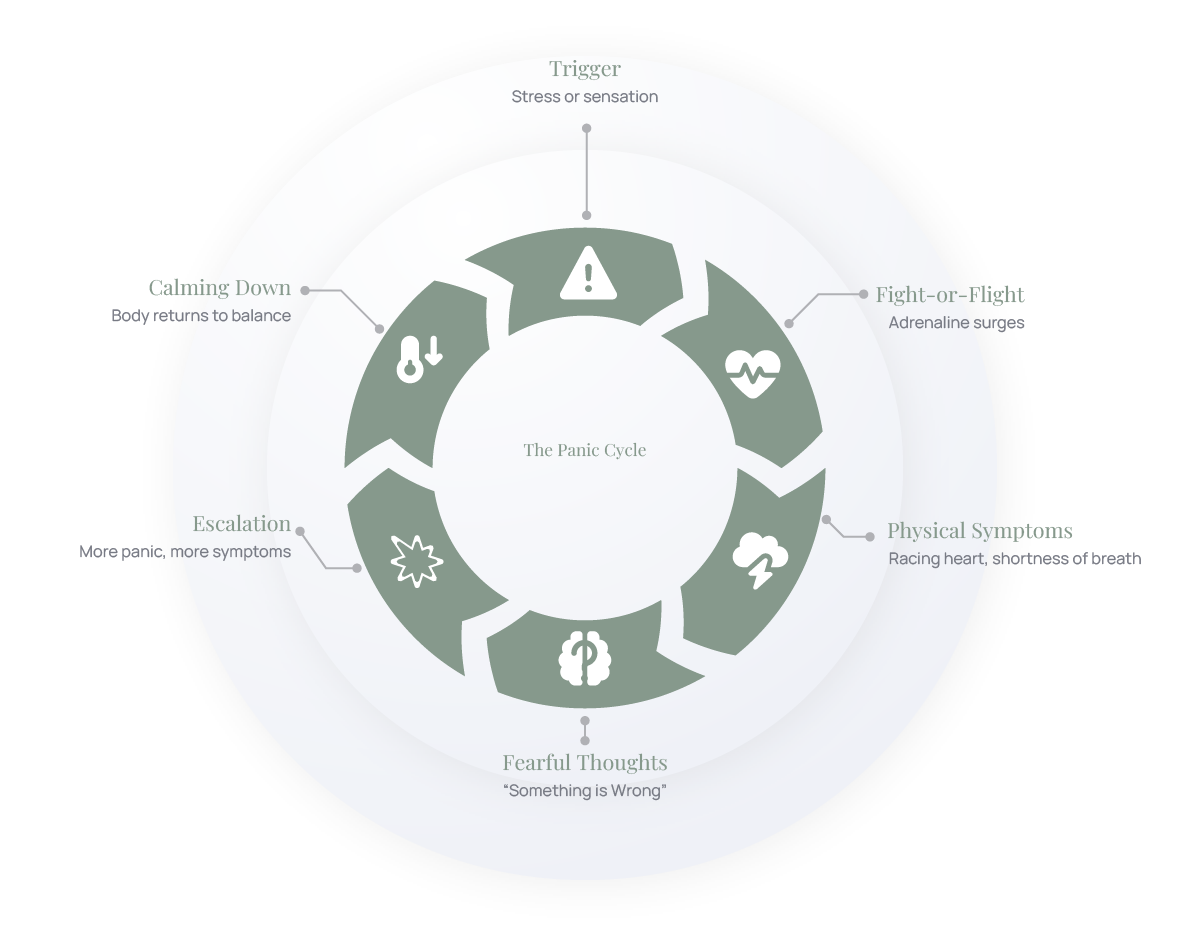
The Panic Attack Cycle
1. A Trigger Appears
Something starts the anxiety response. This might be:
- A stressful thought
- A physical sensation (like a racing heart)
- A memory
- A crowded environment
- Or sometimes no obvious reason at all
2. The Body Activates the Fight-or-Flight Response
Your nervous system switches into survival mode. Adrenaline and stress hormones are released, preparing your body to deal with danger. This can cause physical sensations such as:
- Racing heart
- Tight chest
- Shortness of breath
- Dizziness
- Sweating
- Tingling in hands or face
- Feeling detached or unreal
3. The Mind Interprets the Sensations
At this point the brain tries to explain what is happening. Because the sensations are intense, the mind may jump to frightening conclusions such as:
- “I’m having a heart attack.”
- “I can’t breathe.”
- “Something is seriously wrong.”
- “I’m about to faint.”
4. Fear Increases the Physical Symptoms
The fear tells your brain that the threat is real. This causes the body to release more adrenaline, which makes the symptoms stronger. The cycle now feeds itself: Physical sensation → scary thought → more fear → stronger sensations This is often called the panic feedback loop.
5. The Peak
Most panic attacks peak within 5–20 minutes. Although the sensations can feel unbearable, the body cannot stay in this heightened state forever. The nervous system eventually begins to calm down.
6. The Nervous System Settles
Adrenaline levels slowly fall. Breathing begins to regulate. Heart rate slows. The body returns to balance. Many people feel tired, shaky, or emotionally drained afterwards.
6. The Nervous System Settles
Adrenaline levels slowly fall. Breathing begins to regulate. Heart rate slows. The body returns to balance. Many people feel tired, shaky, or emotionally drained afterwards.
The Important Thing to Remember
A panic attack is not dangerous.
It is the body's natural alarm system reacting too strongly to something that is not actually a threat.
Your body is trying to protect you, even though it feels frightening in the moment.
Why Understanding the Cycle Helps
When you recognise the pattern, you can begin to interrupt it.
Instead of thinking:
“Something terrible is happening to me.”
You can remind yourself:
“This is my anxiety response. My body will calm down.”
That small shift in understanding can sometimes be the first step in breaking the cycle.